


Zakat, Fitr and Fidyah: What? How much? To whom?
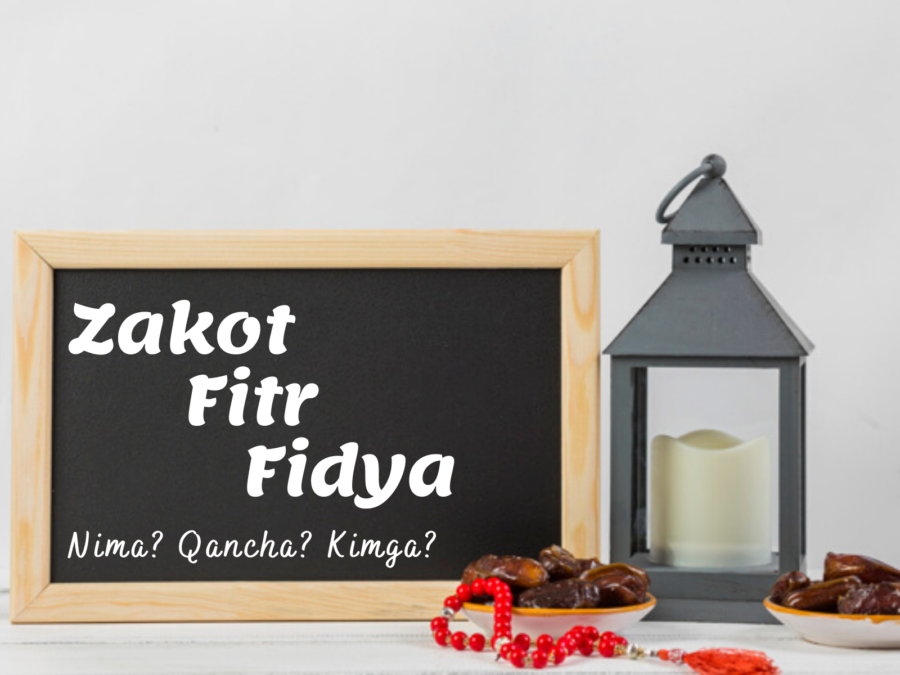
As is known, during the month of Ramadan, primarily three types of financial worship are performed. These are Zakat, Fidyah, and Fitr. Below we provide information about these acts of worship once again.
ZAKAT
Zakat is one of the pillars of our religion. It is an obligatory financial worship for every free, sane, adult Muslim whose wealth has reached the Nisab threshold and one lunar year has passed over it.
The Fatwa Committee of the Muslim Board of Uzbekistan, considering the current average price of 1 gram of gold as 250,000 (two hundred fifty thousand) UZS, set the ZAKAT Nisab (85 grams of gold) for the Gregorian year 2020 (Hijri 1441) at 21,250,000 (twenty-one million two hundred fifty thousand) UZS. One-fortieth (1/40) of this amount, i.e., the portion to be given as Zakat, is 531,250 (five hundred thirty-one thousand two hundred fifty) UZS.
The Qur'an states that Zakat should be given to the following eight categories of people: "Charities are only for the poor, the needy, those employed to collect them, those whose hearts are to be reconciled (to the faith), for (the ransom of) slaves, for those in debt, for the cause of Allah, and for the wayfarer (traveler). (This is) an obligation from Allah. And Allah is All-Knowing, All-Wise." (Surah At-Tawbah, verse 60).
Now let us examine this matter in more detail:
- The Poor (Fuqara) – those who have enough money for food, drink, and clothing, but their wealth has not reached the Nisab threshold.
- The Needy (Masakin) – in Uzbek terms "bechora", i.e., helpless, extremely poor people;
- Those employed to collect Zakat. This category can be said to be non-existent in our country today;
- Those whose hearts are to be reconciled to Islam. Today, sharing Zakat with people of other faiths to invite them to Islam has been deemed unnecessary and discontinued;
- For the ransom of slaves. Since slavery does not exist today, naturally this category is also absent;
- Those unable to repay their debts – debtors who are suffering under the burden of debt;
- Those in the cause of Allah. Some scholars interpret that giving Zakat to seekers of knowledge is considered as being in the cause of Allah;
- Travelers (Musafir). Even if a traveler is wealthy in his homeland, during his journey he may run out of funds to return to his country. Therefore, giving Zakat to them is prescribed. Today, due to the coronavirus pandemic, borders, cities, businesses, and educational institutions have been quarantined, leaving thousands of our compatriots abroad unemployed and without funds; undoubtedly, the Zakat of wealthy Muslims would be of great help at such times.
FITR
Narrated by Abdullah ibn Umar (may Allah be pleased with him): "The Messenger of Allah (peace be upon him) made Fitr Zakat obligatory upon Muslims, one Sa' of dates or one Sa' of barley, for slave and free, male and female, young and old. He commanded that it be given before people go out to the (Eid) prayer." (Bukhari and Muslim).
Fitr Sadaqah is given from four items. These are: half a Sa' of wheat, one Sa' of barley, half a Sa' of raisins, and one Sa' of dates. One Sa' is approximately 4 kilograms.
Accordingly, the amount of FITR Sadaqah for this year was set as follows:
- 2 kg of wheat – 8,000 UZS;
- 4 kg of barley – 12,000 UZS;
- 2 kg of raisins – 70,000 UZS;
- 4 kg of dates – 120,000 UZS.
It is sufficient for each person to give Fitr Sadaqah from any one of these four products according to their ability.
Fitr Sadaqah is called "Sadaqat al-Fitr" in Arabic. That is, the dawn of the day of Fitr (Eid) becomes the cause for this charity to become obligatory. Accordingly, Fitr Sadaqah is also obligatory for a child born at dawn on the day of Eid. It is not obligatory for a child born after dawn. Fitr Sadaqah is waived for a person who dies at dawn, but it is not waived for a person who dies after dawn.
Fitr Sadaqah purifies the Ramadan fast from mistakes and shortcomings.
Fitr Sadaqah becomes obligatory to give at dawn on the day of Eid. However, it is also permissible to give it earlier. It should not be delayed until after the Eid prayer.
FIDYAH
Our Shariah allows elderly people who are completely unable to fast due to old age and are physically weakening day by day, as well as chronically ill patients who have no hope of recovery, not to fast. Muslims belonging to this category pay Fidyah for each day of Ramadan. Those who pay Fidyah may also give all of their Fidyah at once at any time during the month of Ramadan.
If a person who paid Fidyah later regains strength and becomes able to fast, they must make up the missed fasts.
For the Gregorian year 2020 (Hijri 1441), the amount of FIDYAH is equivalent to one Miskin's (needy person's) daily food, and its average value was set at 20,000 (twenty thousand) UZS.
Fitr Sadaqah and Fidyah are given to those who are eligible to receive Zakat.
Source: zakotim.uz