

What is Zakat? What is its amount and why is it given only in Ramadan? Interview with Muzaffar Husniddinov, founder of "Zakotim.uz"
Whenever the month of Ramadan arrives, people begin to ask questions such as: "Is Zakat obligatory on all Muslims, what is its amount, who is eligible to receive Zakat? How much money should I give? How do I calculate the Nisab of my wealth?"
"Daryo" compiled several questions of interest to our compatriots and interviewed Muzaffar Husniddinov, the founder of the "zakotim.uz" project.
Muzaffar Husniddinov is a specialist in the field of Islamic finance. He holds an MBA in Finance from South Korea and studied Islamic finance in the United Kingdom and Turkey.
He is a Certified Shariah Advisor and Auditor (CSAA) for the Accounting and Auditing Organization for Islamic Financial Institutions (AAOIFI).
He is one of the founders of the "Zakotim" and "Islamic Finance" projects. Currently, he is a UNDP consultant on developing legislation for the issuance of "sukuk" securities in Uzbekistan, and a finance manager at IsBF company.
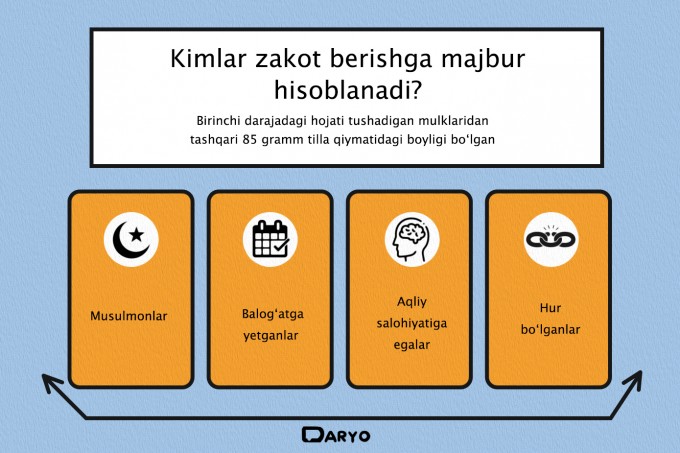
- Let's first discuss the role of Zakat in the life of a Muslim. Zakat is one of the obligatory acts prescribed for every believer. However, not everyone can afford it. Who is obligated to pay Zakat in Islam?
- Indeed, Zakat is one of the acts prescribed for Muslims in Islam. It is not personal charity or voluntary generosity, but a mandatory financial worship prescribed by Allah for the wealthy.
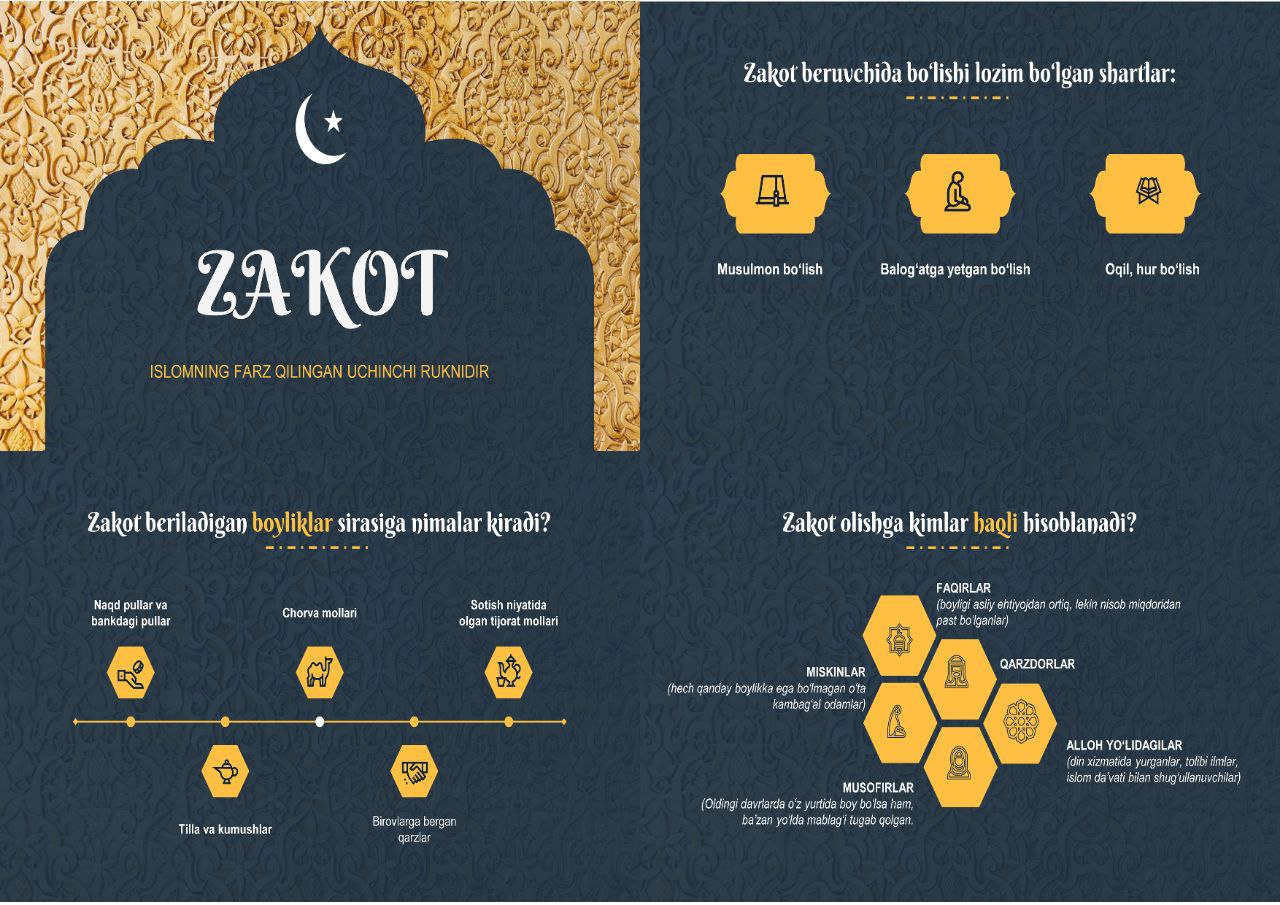
In Islam, a wealthy Muslim is defined as a person who possesses wealth equivalent to 85 grams of gold, excluding their primary necessities. If a person's wealth reaches this threshold and after one year they still have wealth above this amount, Zakat is obligatory upon them.
Paying Zakat purifies the giver's heart from selfishness and greed for wealth, and increases their compassion and goodwill towards the poor.
Moreover, Zakat removes envy and malice from the recipient's heart towards the giver, and strengthens mutual respect and brotherhood in society. If the Zakat system is properly implemented, poverty can be completely eradicated from society.
- What will be the consequence if a Muslim whose wealth has reached the Nisab does not pay Zakat?
- It is necessary to explain that paying Zakat is obligatory for all wealthy Muslims, and to convey this to those who are unaware. The Quran and hadiths promise severe punishment in the Hereafter for those who do not pay Zakat. Merely remembering these hadiths shakes a person with faith in their heart.
Specifically, a hadith narrated by Abu Huraira (may Allah be pleased with him) states: "The Messenger of Allah (peace be upon him) said: 'Whoever Allah has given wealth and he does not pay its Zakat, then on the Day of Resurrection, his wealth will appear to him as a bald-headed venomous snake with two black spots over its eyes. It will coil around his neck and bite him, saying: "I am your wealth, I are your treasure."'" (Bukhari).
There is no blessing (barakah) in wealth from which Zakat has not been given. According to our teachers, blessing is not only in the value or abundance of wealth, but also in peace of mind, protection of loved ones from incurable diseases, prevention of various unexpected calamities, and Allah's protection. In other words, blessings are not measured only by money.
On the contrary, giving Zakat is mentioned in several places in the Holy Quran as a distinctive quality of true Muslim believers (Surah At-Tawbah, verses 18, 71; Surah Al-Mu'minun, verse 4). Paying Zakat is mentioned as a factor that brings about Allah's mercy and assistance (Surah Al-A'raf, verse 156; Surah Al-Hajj, verses 40-41).
Furthermore, as I mentioned above, Zakat has an unparalleled role in ensuring justice in society and eliminating poverty and begging.
- Every year during Ramadan, many programs are broadcast and articles are published about giving Zakat. This raises a pertinent question: Is Zakat given only in Ramadan?
- A person should keep track of their wealth. The date when their wealth reaches the Nisab is marked according to the lunar calendar, and Zakat becomes obligatory on that date each year. The reason some people in our country have made it a tradition to give Zakat in Ramadan is probably because they hope for the blessings and grace of Ramadan, and because good deeds done in this month are rewarded 70 times more.
One does not have to wait for Ramadan to give Zakat. Especially when there is an urgent need from those eligible for Zakat, if one fulfills their obligation, its reward is great, and our teachers say it is like applying ointment to a wound.
- As a natural follow-up to the above question, let us clarify another issue: the Zakat Nisab is announced at the beginning of each Ramadan. What is it based on?
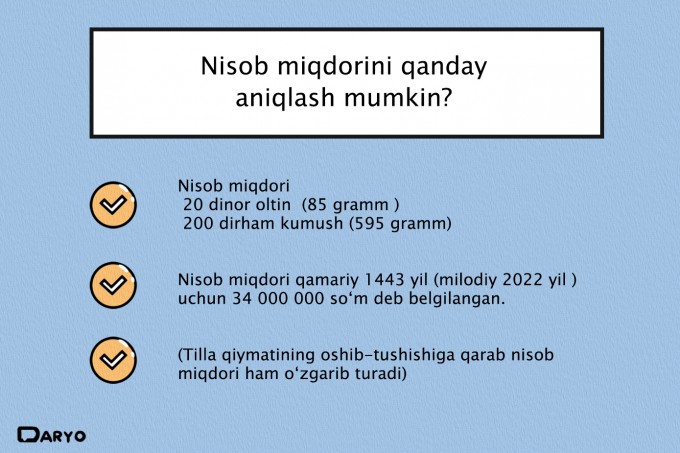
- The original Nisab amount is 20 dinars of gold or 200 dirhams of silver. This is approximately 85 grams of gold or 595 grams of silver. In Uzbekistan, the Nisab amount announced annually by the Muslim Board of Uzbekistan is determined based on the price of gold. The Nisab amount changes as the value of gold fluctuates.
The following formula can also be used to use or approximate the Nisab amount announced by the Muslim Board:
Nisab = 1 gram gold exchange price x 585/999 (fineness) x Central Bank exchange rate
That is, by finding out the value of pure gold on the global market via the internet, extracting the share of 585-carat gold (which is more commonly used in gold items in our country), and converting it to Uzbek soums at the Central Bank exchange rate, one can determine the approximate Nisab value on a specific date. Our esteemed scholars in Uzbekistan do not object to this calculation method.
However, the Nisab amount is announced specifically during this month to spare people from calculating it themselves, to make it easier for our people, and also taking into account that most people give their Zakat in Ramadan.
- How can a person determine how much Zakat to give?
- Since Zakat is given once a year, not everyone learns the calculation method. Because we work in the field of Islamic finance, entrepreneurs and businessmen ask: "How do I calculate my Zakat?"
To simplify Zakat calculation, we launched the "zakotim.uz" website. The main goal of the website is to facilitate Zakat calculation not only for ordinary people but also for entrepreneurs and investors whose activities are more complex, with multiple businesses and various investments.
Users who wish to calculate their Zakat can step-by-step calculate Zakat not only from their cash and gold, but also from commercial goods, investments made, real estate, debts, and even their ongoing business. The Zakat calculator is recommended for use by the Muslim Board of Uzbekistan. Its compliance with the Hanafi school of thought and Zakat jurisprudence has been verified by prominent scholars in our country and teachers at the Tashkent Islamic Institute. The Zakat calculator can be accessed and used for free on the "zakotim.uz" website. Project news is announced on the Telegram channel.
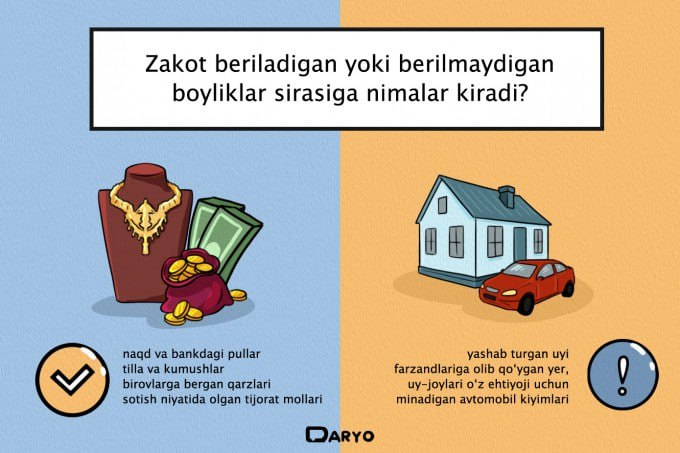
- What types of wealth are subject to Zakat and what are exempt?
- To calculate Zakat, one must first study the types of wealth that are subject to Zakat and those that are exempt. Wealth that is subject to Zakat must reach the Nisab, be in the owner's possession, be surplus to primary needs, and also be growing wealth. "Growing wealth" means, for example, sheep, goats, horses, or camels that graze on pasture and multiply on their own. Although cash and gold do not multiply on their own, they have the capacity for growth, meaning their value increases if invested.
Thus, wealth subject to Zakat includes a person's cash and bank deposits, gold and silver, loans given to others, and commercial goods intended for sale. For entrepreneurs and investors, if they have any business activity or investments in addition to these, Zakat must also be paid from them.
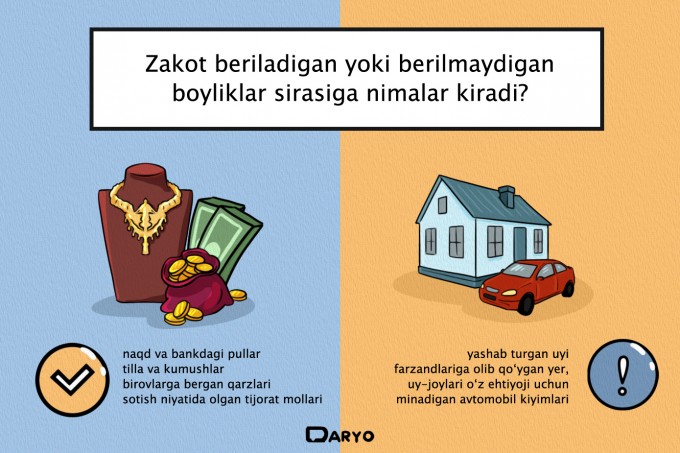
Wealth exempt from Zakat includes any wealth a person uses for their needs, such as the house they live in, land or property set aside for their children, the car they drive for personal needs, clothing, etc. Also, many people think that Zakat is payable on rented houses or cars. Zakat is not payable on rented houses, buildings, cars, etc. Rather, Zakat is payable from the income generated from these only if it is added to the total wealth and saved in cash or other form on the Zakat due date.
Furthermore, wealth subject to Zakat should be free of debt. That is, if a person has debts, this amount is first subtracted, and if the remaining wealth exceeds the Nisab, then Zakat is paid.
Also, nowadays some people have long-term debts of 5-10-15 years. If these debts were deducted entirely, it might result in a person not paying Zakat at all. Therefore, considering the interests of Zakat recipients, a fatwa has been issued that only the portion of such long-term debts due within the coming year may be deducted.
- Must Zakat only be given in cash? Can livestock breeders or craftsmen give their products as Zakat?
- According to our Hanafi school of thought, Zakat should be given in cash based on the value of any property. However, considering the benefit of the Zakat recipient, one may give some product they possess as Zakat. Provided that this product is something the recipient needs. For example, if a person's business is sewing and selling clothes, they cannot give a bunch of fabric or thread as Zakat – because the recipient may not need these items. Or if a person produces polyethylene bags, it would not be logical for them to give polyethylene raw materials as Zakat.
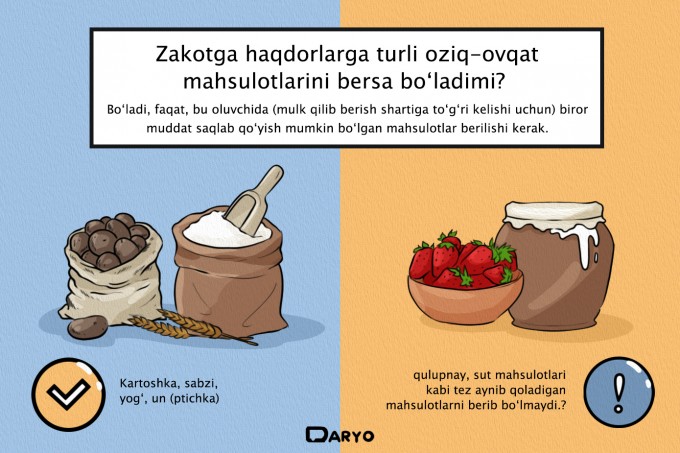
People often ask whether it is permissible to buy various food products and give them to those eligible for Zakat. It is permissible, but only products that can be stored for some time should be given to the recipient (to satisfy the condition of giving ownership). For example, products that spoil quickly like strawberries or cream cannot be given.
As for livestock breeders, if a person is raising sheep or cattle with the intention of selling them, Zakat is calculated by adding their value to cash, gold, and other assets. No Zakat is payable on a couple of sheep or cows kept at home for milk or personal use. However, if there are livestock animals that graze on pastures or fields, Zakat becomes due when they reach the Nisab. For example, when the number of sheep and goats reaches 40, one is given as Zakat; nothing is due before that. Similarly, Zakat becomes obligatory when cattle reach 30, and when camels reach five.
Craftsmen pay Zakat from their commercial property intended for sale. As mentioned, if it benefits the recipient, they may give their product; otherwise, giving in cash is preferable.
- Who is entitled to receive Zakat in our religion?
- The people entitled to receive Zakat are designated by Allah. In verse 60 of Surah At-Tawbah of the Holy Quran, Allah explains who is eligible for Zakat. These are: the poor, the needy, those employed to collect Zakat, those whose hearts are to be reconciled (to Islam), those in the cause of Allah, those unable to repay their debts, and travelers.
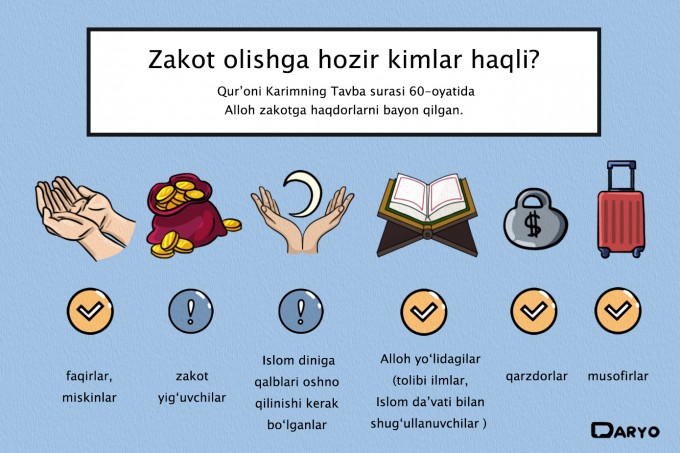
Let me explain each of these.
The Poor (Fuqara) – those whose wealth exceeds their basic needs but is below the Nisab amount. The Needy (Masakin) – extremely poor people who possess no wealth at all.
Those employed to collect Zakat, in the past when there were centralized Zakat collection authorities, received a specified amount appointed by the rulers. Currently, if someone is appointed to deliver Zakat, they cannot take anything from this money for themselves; they must deliver it entirely to those entitled.
Giving Zakat to the category of "those whose hearts are to be reconciled" was discontinued during the time of Umar (may Allah be pleased with him) because Islam had become strong, news about Islam had reached all directions, and there was no longer a need to use Zakat to invite people to Islam.
"Those in the cause of Allah" refers to those serving the religion, seekers of knowledge, and those engaged in spreading Islam. Debtors are also entitled to receive Zakat. Of course, debtors must strive to get out of debt and live without extravagance. Travelers in earlier times, even if rich in their own country, sometimes ran out of funds on the road. Because at that time, money transfers, banks, and communications were not as they are today, so travelers could receive Zakat to reach their homes.
- Can Zakat funds be given for the construction of a hospital or for the tuition fees of needy students? Would this count as Zakat?
- Those who cannot meet their basic needs are indeed the most entitled to Zakat. In Islam, there is a concept of "primary needs" – that all members of society must be provided with the most essential things – food, shelter, clothing, etc.
Regarding building a hospital, in countries where large amounts of Zakat are collected, they have allowed using Zakat funds for construction. However, the condition is that such a hospital can only be used by those eligible for Zakat (the poor, needy, seekers of knowledge, debtors, and travelers). Others cannot use it. If they do, they must pay for it. That money is then given to those eligible for Zakat.
In short, to dispose of Zakat in this manner, one must obtain the conclusion (detailing the conditions for establishing such an institution) and fatwa of the Muslim Board. Because Zakat funds must be given as ownership to those eligible.
If students possess the qualities of those entitled to receive Zakat, it is permissible to give it to them.
- If a person giving Zakat cannot find needy people, to whom can they give it? Are there trustworthy organizations in Uzbekistan that work on this?
Zakat serves as a bridge between the rich and the poor. In the process of searching for those in need of Zakat, a person engages with society, visits the homes of the poor, and establishes direct contact with the needy. In this regard, there are many wisdoms in searching for needy people. However, if one cannot find them, it is permissible to give to an organization that distributes Zakat. This organization must be trustworthy, organized, have a policy for identifying eligible recipients, and be supervised. In Uzbekistan, the Muslim Board and the "Waqf" charity foundation can perform such a task. Additionally, advice on this can also be sought from our imams serving the people.
Interviewed by Khonzodabegim A'zamova.
Source: daryo.uz